
Is your charity missing out on £7,500 a month in free Google Ads?
What if your charity could reach more potential donors, attract volunteers and raise awareness of its cause through Google? And what if you could do all of that without paying Google a single penny for the advertising?
Published on Tuesday, November 3rd 2026 by Viki Nagy
It might sound too good to be true, but it's a genuine opportunity that many charities either don't know about or aren't making the most of. Through its Ad Grants programme, Google offers eligible UK charities up to $10,000 (around £7,500) a month in free Google Search advertising credit. That's potentially £90,000 worth of advertising every year, without having to pay Google a single penny.
If your charity is eligible, it could be putting your cause in front of the people searching for it right now: potential donors, volunteers and people who need your help.
What are Google Ads and Google Ad Grants, and how do they work?
Google Ads is one of the biggest online advertising platforms that allows businesses to appear in Google search results when people look for relevant products or services.
For example, when someone searches for "plumber near me", they might see adverts from local plumbing companies alongside the regular search results. These businesses typically pay Google each time someone clicks on their advert, which is why it's known as pay-per-click (PPC) advertising.
Google Ad Grants works in much the same way, but with one major difference: eligible charities receive up to $10,000 (around £7,500) in advertising credit every month. Meaning they don't have to pay Google for ads covered by the grant. (The grant is set in US dollars, so its value in pounds varies with the exchange rate.)
What does it Mean for your charity?
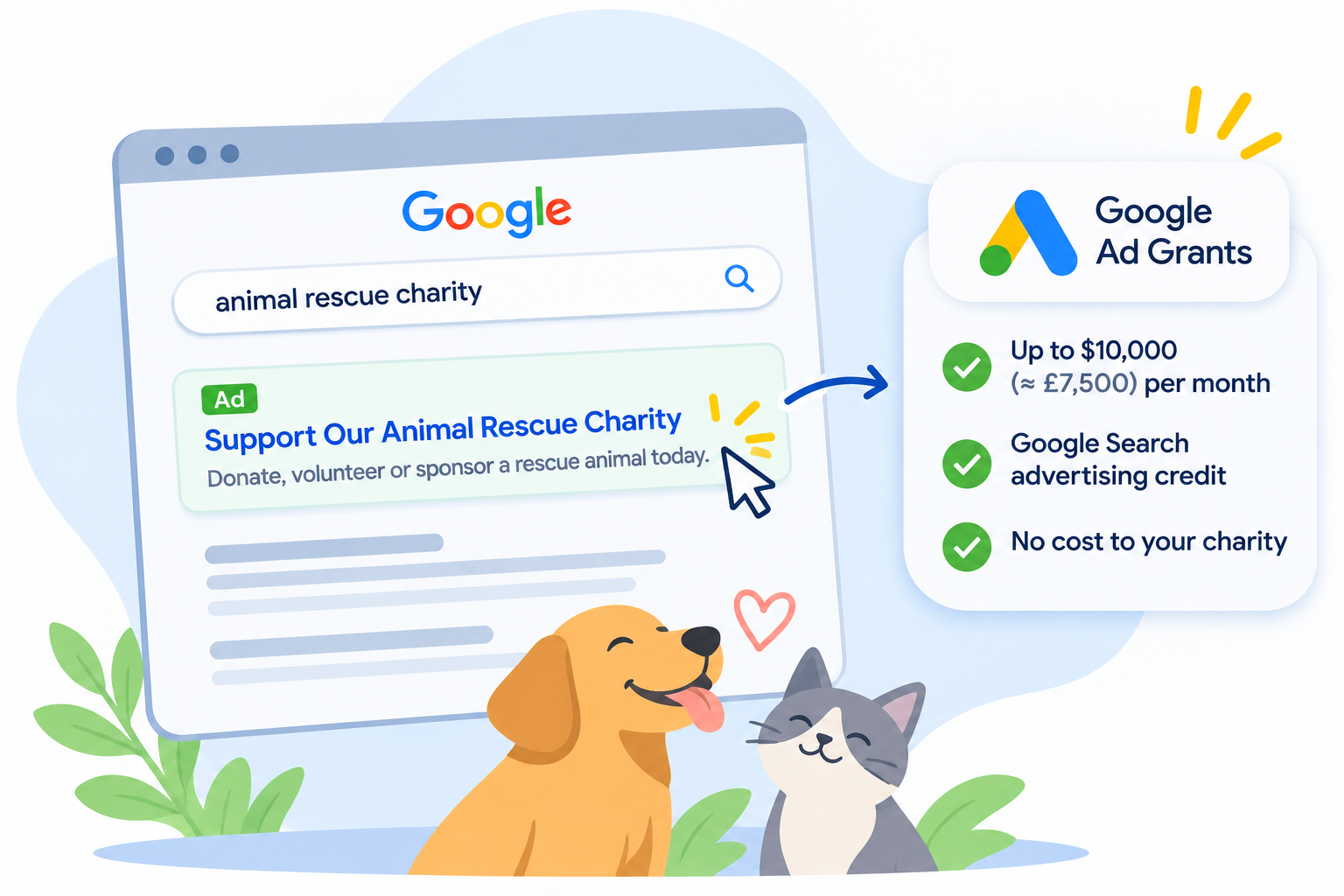
This means your charity can display adverts in relevant Google search results and reach people actively looking for the services, support or opportunities you offer, with the cost of eligible clicks covered entirely by the grant.
For example, imagine you run an animal welfare charity. Your advert could appear when someone searches Google for:
"Donate to animal charities" "Animal shelter volunteering near me" "Sponsor a rescue animal" "Animal rescue charity near me"
These searches are performed by people already interested in supporting a cause like yours.
Google Ad Grants gives your charity the opportunity to reach these people at the very moment they're looking to take action. This can be an enormous help if you would like to attract potential donors, volunteers and supporters without paying for the advertising itself.
And there are two more benefits worth knowing:
There's no fixed time limit. As long as your charity remains eligible and follows Google's programme requirements, you can continue benefiting from the grant month after month.
There's no minimum advertising spend. You don't have to use the full allowance or contribute financially from your own budget. Google covers eligible advertising costs entirely up to the monthly grant limit. In other words, your charity could benefit from thousands of pounds' worth of Google Search advertising every month, without paying a single penny to Google.
Is your charity eligible?
Most UK charities are. To qualify, your organisation needs to:
-
be registered with the Charity Commission (England and Wales), OSCR (Scotland) or the Charity Commission for Northern Ireland, or be recognised by HMRC as a charity for tax purposes
-
be verified through Goodstack, Google's charity verification partner
-
have a secure, good-quality website with clear information about your work
-
agree to the Google for Nonprofits terms
Some organisations, including government bodies, hospitals and schools, are generally excluded, although there are exceptions, such as the fundraising arms of some universities.
Not sure whether your charity qualifies? Webbed Feet can check the requirements with you and explain the next steps.
What a well-run grant can do for your charity
When the grant is set up around your goals, it reaches people at the exact moment they're looking for what you offer.
Depending on your aims, it can help you:
-
Raise donations. Reach people searching to give to causes like yours, including at key moments such as Christmas, Giving Tuesday and emergency appeals.
-
Recruit volunteers.
-
Appear when people search for volunteering opportunities in your area.
-
Reach people who need you. Make sure someone searching for help at 2am finds your service, not a forum post.
-
Fill events and challenges. Promote fundraising runs, open days and campaigns.
-
Grow your mailing list. Point people to guides, petitions or sign-ups that start a longer relationship.
-
Build awareness. Get your expertise in front of people researching the issue you work on.
Because the advertising is free, every donation, volunteer or person helped is a gain you're not paying for.
Is the Google Ad Grant really free?
Yes. Google provides the advertising credit at no cost to eligible organisations. But there are a few things to understand:
-
It's advertising credit, not cash. You can't withdraw it or use it for other charity costs.
-
It comes with requirements. The advertising must follow Google's programme rules, requirements and restrictions.
-
Management isn't included. Google doesn't charge for grant-funded advertising, but you may choose to pay an agency to help with the application, setup and ongoing management.
The rules that get charities suspended
The grant is free, but it comes with strict conditions. Google checks accounts automatically, and an account that breaks the rules can be suspended without warning. These are the ones that catch charities out most often.
-
The 5% click-through rate rule. At least 5% of people who see your search ads must click them. If the account falls below 5% for two months in a row, it's switched off.
-
Conversion tracking. You must track meaningful actions on your website, such as donations, sign-ups or enquiries, and the tracking must actually work.
-
No single-word keywords. Broad terms like "charity" or "donate" aren't allowed, apart from a few exceptions Google allows.
-
Low-quality keywords. Keywords Google rates very poorly get paused.
-
Account structure. Campaigns need proper location targeting, at least two sitelinks, and ads grouped by theme.
-
The yearly survey. Google sends a programme survey once a year. Miss it and your account can be deactivated.
-
Your website. It must stay secure, up to date and clearly about your charitable work.
And here's the only small catch, if you've been looking for one. None of these requirements is particularly difficult to satisfy for someone experienced in Google Ads. But managing Google Ads campaigns does require specialist knowledge and a thorough understanding of Google's advertising policies.
Even seemingly small mistakes can affect performance or put the grant at risk of suspension. This is why having experienced professionals manage your account can make a real difference for your charity.
Already have a Google Ad Grant, but not seeing results?
Even if your account is active and follows Google's rules, it may not be delivering the results your charity could be getting.
Many charities have campaigns running without realising how much they're missing. Your ads might attract clicks but not donations, volunteer sign-ups or enquiries. Or you might be using only a small part of your £7,500 monthly credit.
An active account isn't the same as an effective one. The goal isn't simply to spend the full £7,500 every month. It's to turn that free advertising into meaningful results for your charity, whether that's more donations, more volunteers or more people using your services.
Common reasons include:
-
Your keywords aren't reaching the right people. They may be too broad, too narrow, or not match how people actually search.
-
Your campaigns aren't properly optimised. Ads, keywords and settings haven't been reviewed or improved since the account was set up.
-
Your website isn't converting visitors. Even a successful campaign can struggle if people can't easily find information, donate or contact you.
How Webbed Feet can help your charity
At Webbed Feet, we understand that charities need to make the most of their resources. We're a Google Partner agency, and we've been building websites and running digital marketing since 2001. Because our team covers both, we can help with more than setting up adverts, including fixing any website issues that stand in the way of approval.
We can support your charity with:
-
Eligibility and applications: understanding the requirements and preparing your application.
-
Account setup: creating campaigns, researching keywords and configuring your account.
-
Ongoing management: monitoring and improving your campaigns to reach the right people and keep your account within Google's rules.
-
Conversion tracking: measuring donations, volunteer applications, enquiries and other meaningful actions.
-
Website and landing page improvements: making it easier for visitors to take the next step.
-
Existing grant reviews: finding ways to improve an account you already have.
Whether you're applying for the first time or have a grant that isn't delivering what you hoped, we can help you find a sensible way forward.
Find out How your charity could benefit
You don't need to know anything about Google Ads to start the conversation. Just tell us whether:
-
your charity has never applied for Google Ad Grants.
-
you've applied but need help getting started.
-
you already have a grant and want better results.
-
your account has been suspended.
We'll talk through your situation, explain how we can help and outline the next steps.
Already have a grant? Book a free health check
If you're not sure how your grant is performing, or your account has been suspended, book a free 15-minute health check. There's no obligation, and you'll come away knowing whether your charity is getting full value from the grant, and what to fix if it isn't.
Call 01722 346400 or enquire about Google Ad Grants online.

Frequently Asked Questions
How long does it take to get the grant?
It varies. Verification and Google's review usually take a few weeks in total. Delays tend to come from missing paperwork or a website that needs improving first.
What can we advertise?
Anything connected to your charitable mission: services, donations, volunteering, events, campaigns and advice. You can't use the grant to sell products for commercial gain.
Can we use the grant alongside paid Google Ads?
Yes. Many charities run a separate paid account for activity the grant doesn't suit, such as display or YouTube ads, or highly competitive appeal terms.
Our account has been suspended. Can we get it back?
Usually, yes. Once the account is brought back within the rules, you can ask Google to reinstate it. We can work out what went wrong and fix it.
We're a small charity. Is it worth it for us?
Often it's most valuable for small charities, because it gives you the kind of visibility larger charities pay thousands for. A few well-built campaigns can make a real difference.
About Viki Nagy

Viki first fell in love with digital marketing during her internship at a buzz marketing agency while studying Communication and Media Science in Budapest.
Viki has a passion for data-led creativity; she loves bringing insight and creative magic together.
 01722 346400
